Scanning is the habit of looking around the pitch before the ball reaches you, so that your first touch and your next pass are already decided when it arrives. Players who do it receive with their body already pointed at the space they want. Players who don’t do it spend the first half-second after the touch finding out where everyone is, and that is usually when a defender closes them down.
The drills below build that habit with cones, bibs, a ball and a wall or a partner. Each one has a scan cue (the moment you look), a decision attached, and a way to check that it is working.
What scanning actually is, and a two-minute test to see if you do it enough
A scan is a quick head movement away from the ball to take in teammates, opponents and open space. It takes about a second and is repeated while the ball is travelling toward you. Watching the ball the whole way in does not count, however alert you feel.
You can find out how much you scan with a simple test and a partner:
- Stand 8 to 10 yards from a wall and pass against it, controlling each return with one or two touches.
- Your partner stands behind you, out of your sight line, and silently holds up one, two or three fingers at a random moment while the ball is on its way back from the wall.
- After each touch, say the number you saw. Do ten passes.
A score of seven or more means you are already looking up between passes. A score of three or four means your eyes follow the ball almost all the time, which is common and fixable. Write the number down, because you will repeat the test at the end of the plan.
The shoulder-check habit: a solo wall or rebounder drill to build it
This is the base drill, and it needs one player and one wall. A rebounder gives a more consistent return, but a flat wall works.
Setup: Pass to the wall from 8 yards. Place a cone with a bib draped over it about 5 yards behind each shoulder, using a different colour on each side.
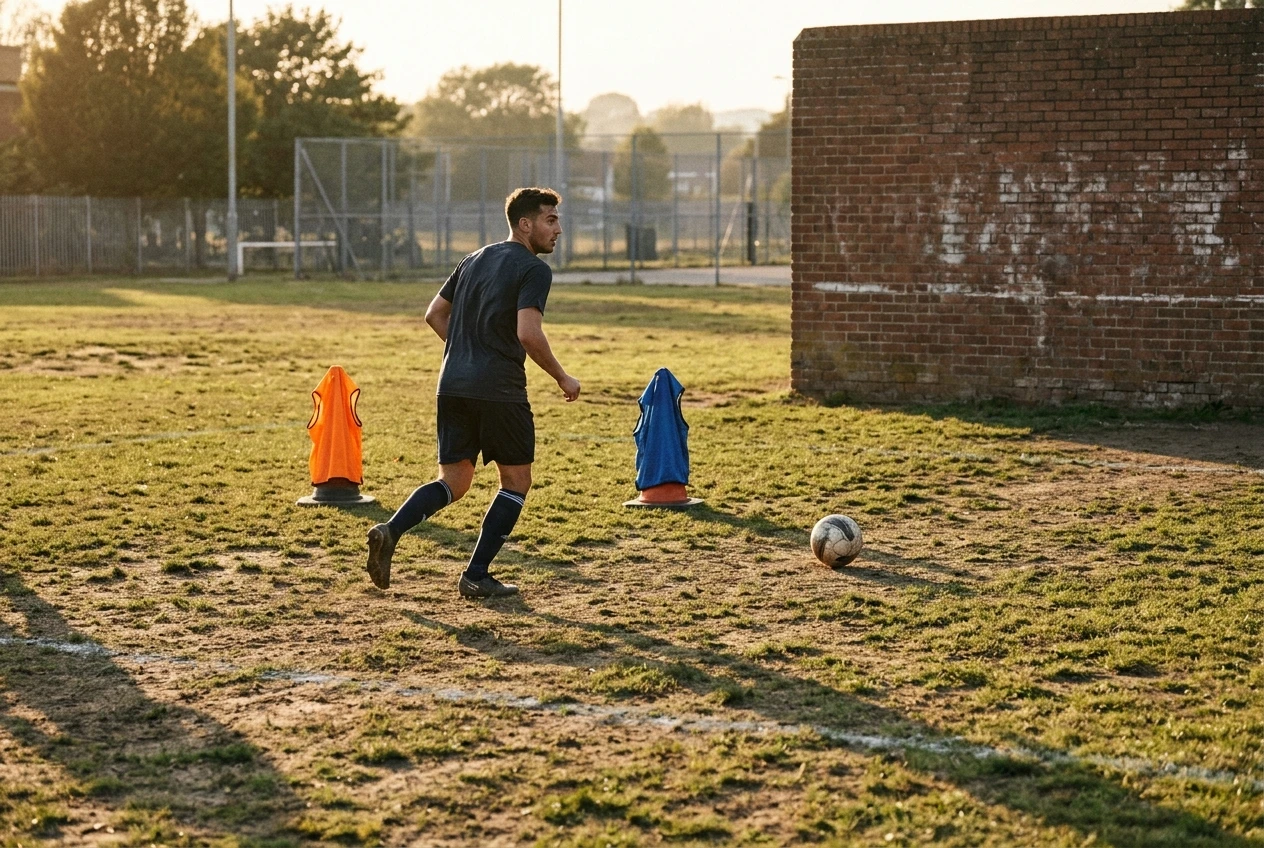
Scan cue: The moment the ball leaves your foot, turn your head over one shoulder and find the bib. Look back at the ball before it returns.
Decision: Call the colour out loud, then take your first touch away from that side. Alternate shoulders each rep, so you cannot settle into a pattern.
Dose: Five sets of ten passes, with 30 seconds’ rest between sets. If you are looking at the cone but flinching at the ball, shorten the distance to the wall until you can look and still control the return cleanly.
How you know it works: You can call the colour on nine of ten reps without mishitting the ball. Once that is easy, have someone swap the bibs between reps without telling you, so you must read them every time.
Colour-call passing: using bibs and cones to force your eyes up
The shoulder check trains the look. This drill trains looking at the right thing under a time limit, and it needs a partner.
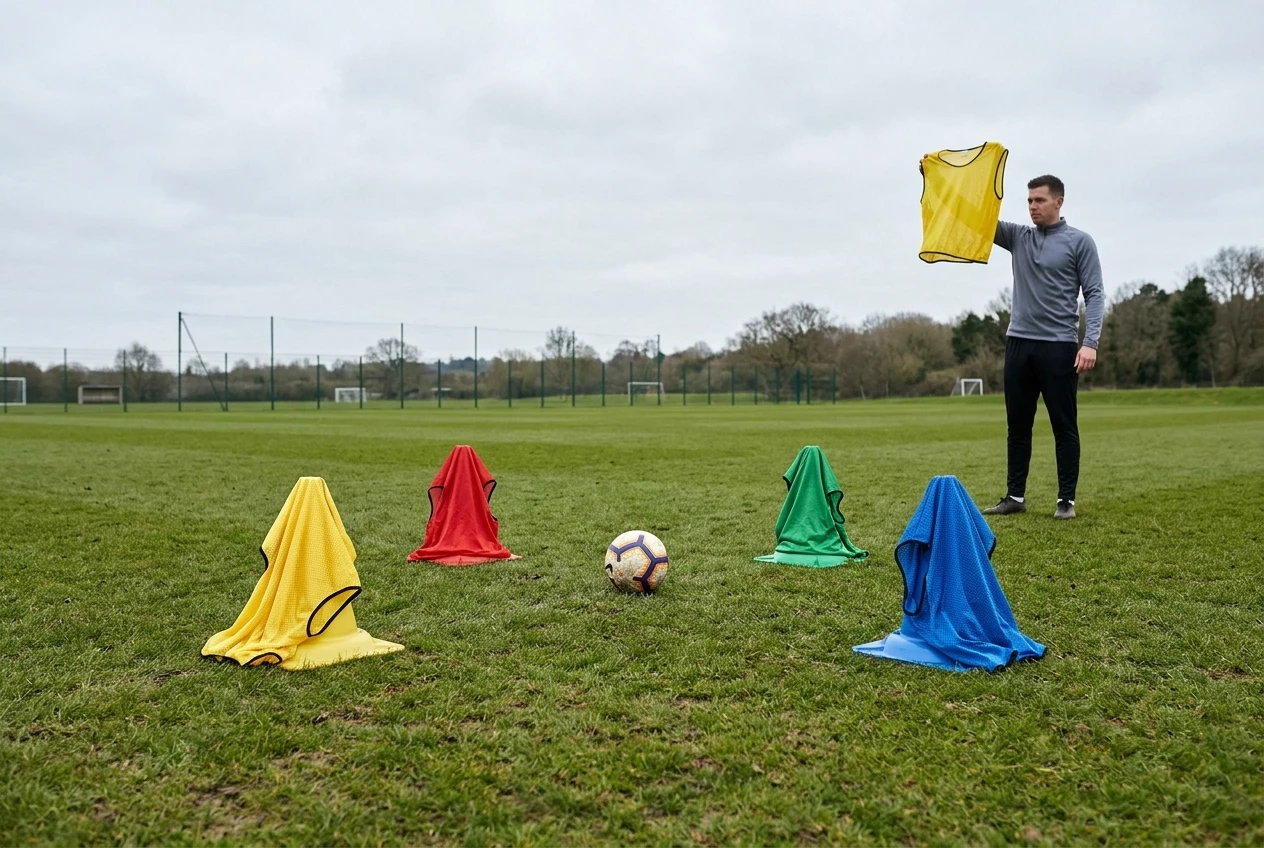
Setup: Mark four cones in a square, 10 yards on each side, with a different bib colour on each cone. You stand in the middle with a ball. Your partner stands on the edge holding a bundle of bibs.
Scan cue: Your partner holds up one bib colour while you are receiving a pass from a second feeder, or while your own ball is rolling to a stop. The colour stays up for only a moment, so you must lift your eyes before the ball arrives to see it.
Decision: Pass to the cone that matches the colour. No pass is allowed until you have seen the bib.
Variations:
- Raise the bib above shoulder height so you must look up and not down.
- Hold two colours at once and tell the player to pass to the cone for the second colour shown.
- Change the rule so the colour tells you where not to pass.
How you know it works: You choose the right cone on eight of ten reps. If you keep guessing, your partner should hold the bib up for less time rather than more, until you only get it right by looking early.
Gate and number: reading what is behind you before you turn
Receiving with your back to the play is where scanning matters most, because you cannot see what you are about to turn into. This drill needs three people: a feeder, a caller and the receiver.
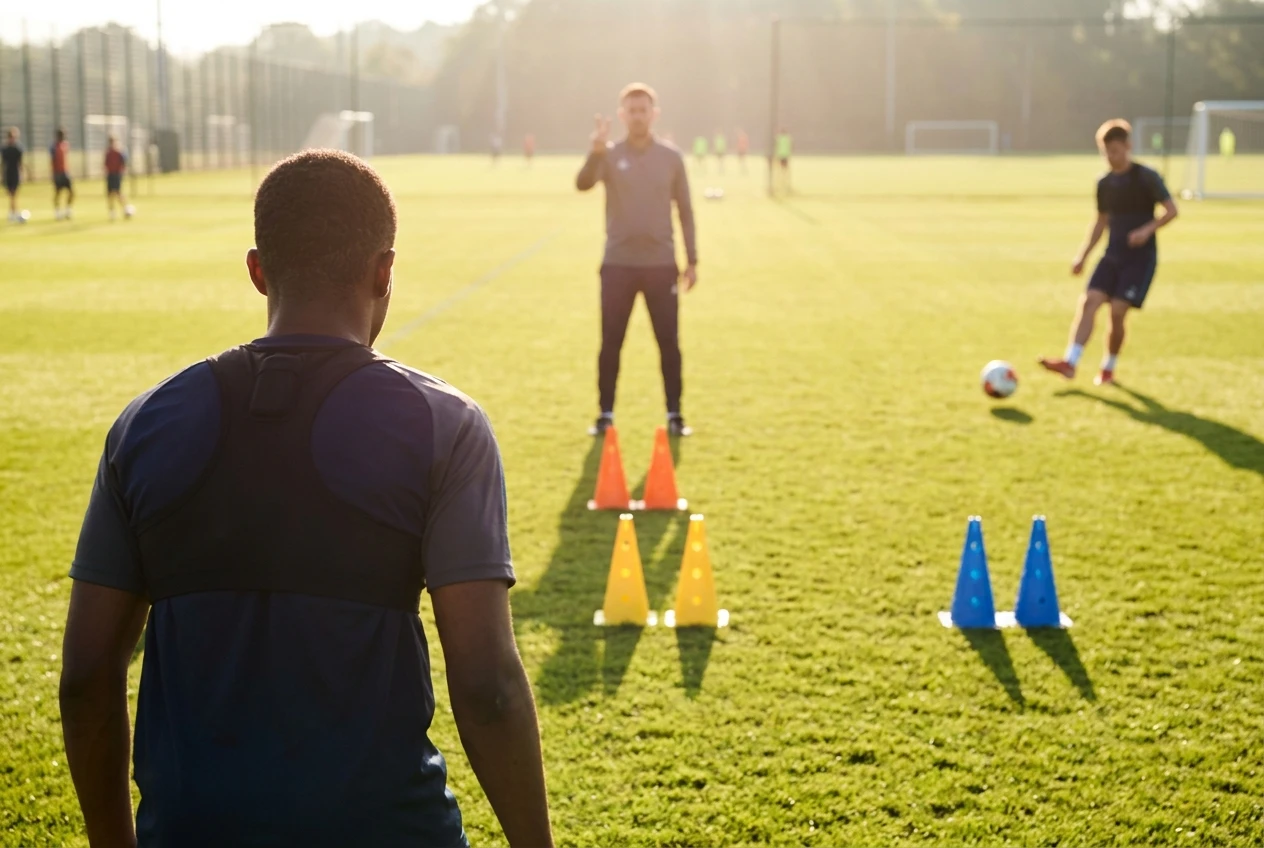
Setup: Build three gates from pairs of cones, each about 2 yards wide. Place them in a semicircle 6 to 8 yards behind the receiver. The feeder stands 8 yards in front of the receiver. The caller stands near the gates, holding up one, two or three fingers to match a gate.
Scan cue: As the feeder plays the ball, the receiver checks over a shoulder and reads the caller’s number.
Decision: Turn and dribble through the gate that matches the number. The caller changes the number after each rep, and sometimes mid-pass to catch players who looked too early.
How you know it works: You pick the correct gate before your first touch, not after it. If you are turning first and looking second, the feeder should slow down the pass until the sequence is look, receive, turn.
With only two people, use the shoulder-check drill instead. The gate version needs a second pair of eyes to be a real test.
Possession game with a scan rule: no pass counts without a look first
Isolated drills build the habit, but a small game tests it when you are tired and distracted. This is the most important step, because it puts scanning into something that looks like a match.
Setup: Mark a 15 by 15 yard grid. Play 4v2 with bibs separating the teams, and have a coach, parent or substitute watch. With fewer players, drop to 3v1 in a 10 by 10 yard grid.
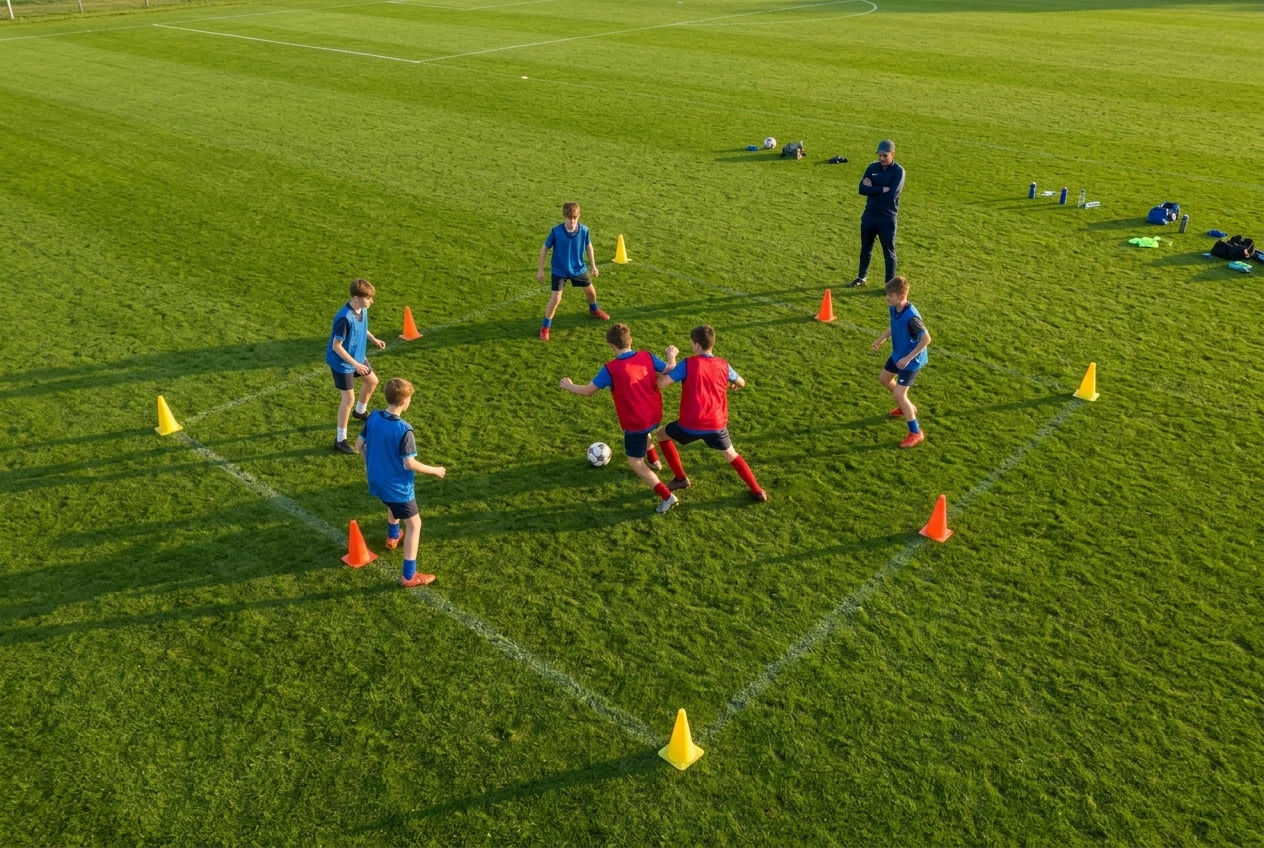
The rule: A pass only counts if the receiver looked away from the ball before it arrived. The watcher calls “no look” whenever a receiver takes the ball with their eyes locked on it. That pass is turned over to the other team.
Scoring: Count consecutive legal passes. The team in possession tries to string together ten before the defenders win the ball.
The first few minutes usually feel clumsy, and possession gets lost often. Players start to move their heads on every receive when it costs them something to skip it. Keep the sessions short, around eight minutes, so the rule stays sharp.
Adding the decision: scanning to choose the pass, not just to look
A scan with no decision attached becomes a nervous head wiggle. Every look should answer a question, and there are only a few to choose from:
- Where is the closest defender? Take your first touch away from that side.
- Is a teammate free and facing forward? If yes, play first-time. If no, keep the ball.
- Is there space in front of me? If yes, dribble into it. If no, play back or sideways.
To train this, give the defender in your possession game a bright bib and call that player “red”. Before each pass, the receiver must answer out loud: “red left” or “red right”. The touch then goes to the other side. A coach can check the call against what actually happened.
This links to the touch work in the first touch under pressure article. A good touch relies on knowing where the pressure is coming from, and scanning is how you find that out.
How you know it works: Your spoken call matches the defender’s real position on most reps, and your first touch goes the other way without you having to think about it.
How to tell it is working: using your own footage to count your scans
Feeling better at scanning does not prove anything, so measure it. A phone propped on a bag or a tripod, filming from the side of the pitch, is enough.
Pick one stretch of play, for example the first ten minutes of the second half, and watch it with a notepad. For every time you receive the ball, note whether your head turned away from the ball at least once in the few seconds before it reached you. Then work out the fraction: receptions with a scan divided by total receptions.
Do this once before you start the plan, then again after four weeks. Your own first number matters more than any benchmark, because the aim is to see it rise. If you are unsure how to set up the camera or what else to look for, the guide to analysing your own match footage covers filming positions and review.
Training footage works too. If the possession game is filmed, you can compare your scanning there with what you do in a match. A large gap shows where the habit has not carried over yet.
A four-week plan to fit scanning into the training you already do
Scanning does not need extra sessions. Ten to fifteen minutes in place of part of your usual warm-up or passing work is enough, three times a week.
Week 1: the shoulder check. Do the solo wall drill, five sets of ten, at the start of each session. Repeat the two-minute test at the end of the week and compare it with your first score.
Week 2: add colour-call. Keep a short block of the shoulder-check drill, then add 8 minutes of colour-call passing with a partner. Increase the speed of the bib changes if you are getting nine out of ten.
Week 3: gates and the scan rule. Use the gate and number drill with three people once or twice. Add the possession game with the “no pass counts without a look” rule at the end of one session.
Week 4: decisions and measurement. Play the possession game with the spoken “red left, red right” call. Film a match or a training game, then count your scans and compare the fraction with your first count.
If a week feels too fast, repeat it. Scanning is a habit, and habits form through repetition more than through variety.
Where to go next
The drills above need very little: a set of cones, a few bibs in different colours, a ball and a rebounder or a wall. The affordable soccer training equipment page lists budget options so you can set everything up without spending much.
Once looking early feels automatic, the next step is deciding well with what you see. The article on how to build tactical intelligence as a soccer player picks up from here.