
If you want to know how to analyze your soccer game, start with what you are looking for. Most players who film their matches watch for goals, saves and mistakes, because those are the moments that stand out. Improvement comes from the decisions behind them: what you saw, what you chose, and how quickly you chose it.
This article lays out a repeatable 30-minute review. You tag your decisions, find one pattern that repeats across three matches, and build a short drill around it. The tactical ideas behind good decisions are covered in our guide to building tactical intelligence. This piece covers the review process and the drills it feeds.
Why most players rewatch their highlights and learn nothing
Watching your best moments feels good, and watching your worst ones feels bad. Neither tells you what to change. A goal you scored from a rebound shows you were in the right place, but not why you were there or whether you would be again. A lost ball in midfield shows an outcome, not the decision that caused it.
Outcomes also mislead. A pass that was a poor choice can still reach a teammate because the defender slipped, and a good choice can fail because the pass was slightly heavy. If you judge decisions by results, you will repeat bad choices that happened to work and drop good ones that happened to fail.
Watching passively also lets you skip over the 80 or so minutes in which nothing dramatic happens. Most of your decisions are made in those minutes: where you stand when a teammate has the ball, when you check over your shoulder, whether you ask for the ball or hide from it. A review that only covers the highlights ignores nearly all of that.
What to film and where to put the camera so the footage is usable
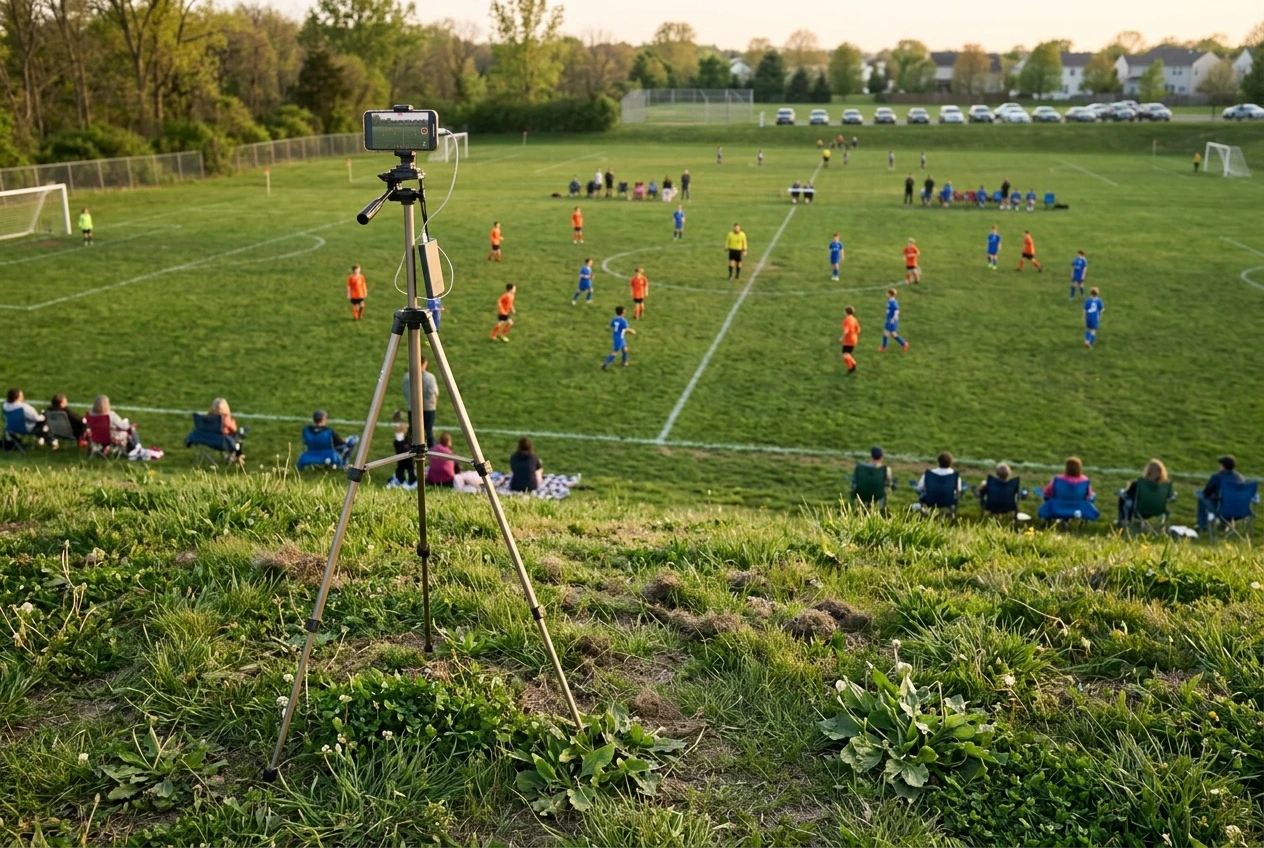
Footage is only useful if you can see your decisions in it. That means seeing the space around you, not only the ball.
- Height: Film from an elevated position if you can, such as a stand, a hill beside the pitch, or a tripod with an extended leg. A low sideline angle stacks players on top of each other and hides the space you were reading.
- Position: Set the camera near the halfway line so both halves are in frame. If you play a fixed role, such as center back or winger, a wide shot that covers your half of the pitch is more useful than one that follows the ball.
- Framing: Film in landscape and keep the shot wide. Whoever holds the camera should resist zooming in on the ball, because you need to see where your teammates and opponents are when you receive it.
- Duration: Record the whole match without stopping. Starting and stopping loses the quiet stretches where positioning decisions happen.
- Setup: Use a tripod or a fixed mount rather than a handheld phone. Charge the device fully and clear storage beforehand, because a one-hour recording uses a lot of both.
Before you film, check your league’s and club’s rules on recording, especially for youth matches, and tell the coach or the match officials where relevant. Rules differ between leagues, and it is easier to ask first.
The 30-minute review: tag decisions, not goals and mistakes
The review has three parts and fits in 30 minutes. Do it within a day or two of the match, while you still remember how the game felt.
Minutes 0 to 5: pick your clips. Choose a fixed window of play to review, such as the first 20 minutes of the second half, rather than hunting for notable moments. A fixed window keeps you from cherry-picking, and you can use the same window in every match.
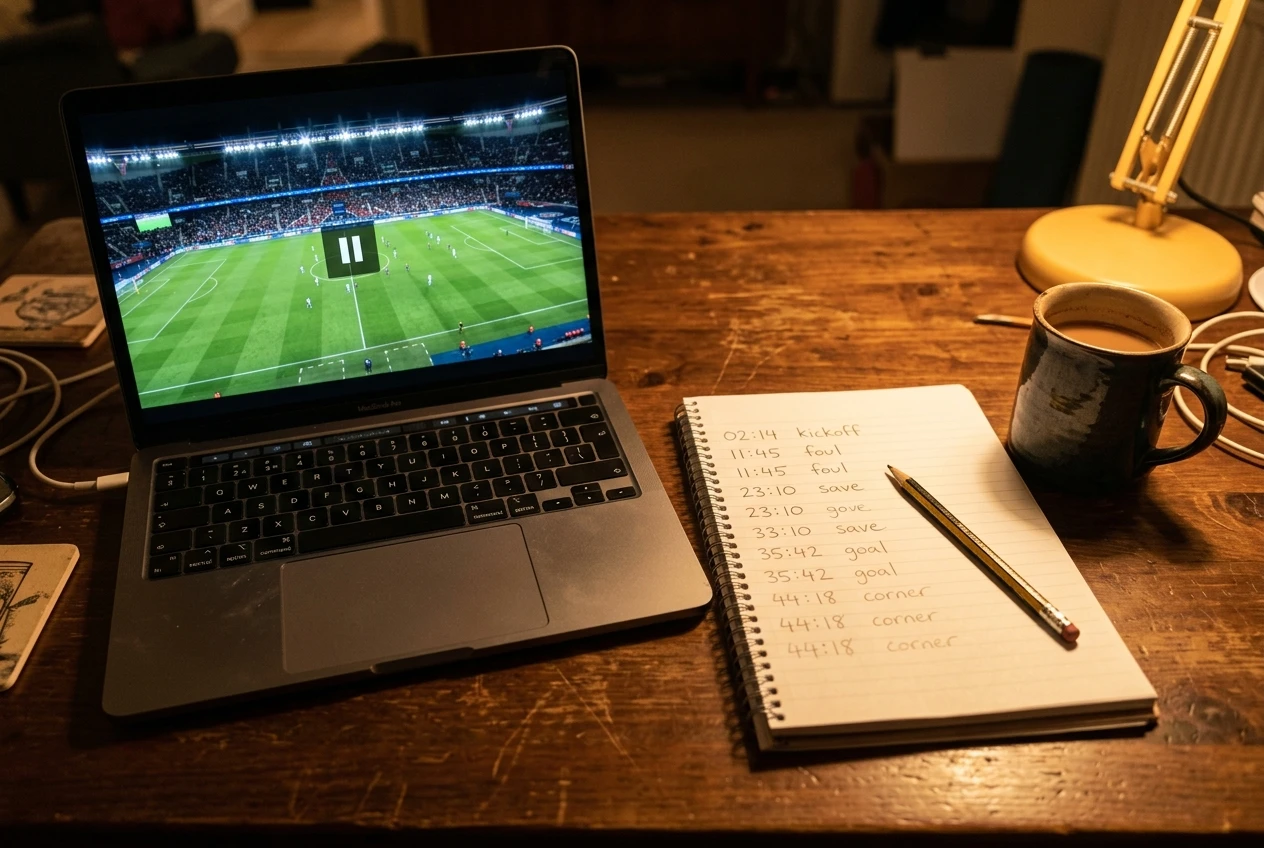
Minutes 5 to 25: tag each time you receive or could receive the ball. Pause at each moment you were on the ball or moving to get it. Write the clip time and one short label for your decision, not for the result. Useful labels include:
- Played forward
- Played back or safe
- Switched play
- Dribbled
- Held the ball
- Took a shot
- Gave the ball away under pressure
Add a second label for what you did before the ball reached you: scanned or did not scan. A spreadsheet works, and so does a notes app or a piece of paper with the clip time on the left.
Judge the decision, not the outcome. If you chose a forward pass and it was intercepted, the tag is still “played forward.” You will decide later whether it was a good choice. The tags give you a record you can count.
Minutes 25 to 30: write one sentence. Finish with a single sentence about what you noticed, for example, “I received facing my own goal in most of the clips and played back.” Do not try to list every problem. One sentence is enough to carry into the next review.
Three questions to ask about every touch: scan, option, timing
For each tagged moment, ask the same three questions. They turn “that looked bad” into something specific you can train.
Scan
Did you look around before the ball reached you? On footage this shows up as head movement: a turn of the head or a shift of the shoulders toward where the space is. If the camera angle is too far away for that, note whether your first touch suggests you knew what was behind you. A player who has not looked usually takes a heavy or hurried first touch, or has to turn into pressure.
Option
What was available that you did not use? Pause as the ball arrives and look at the whole picture. Was a teammate open on the far side? Was there space to carry the ball into? Count the options you could have taken and compare them with the one you chose. This is where a habit of always playing safe, or always forcing the forward pass, becomes visible.
Timing
When did you make the decision: before the ball arrived, on the first touch, or after you had already settled it? Late decisions show up as extra touches, stops, or a body shape that points the wrong way. A quick way to check is to count your touches before the pass or shot. Players who decide early often need one or two touches. Players who decide late need three or more, or lose the ball while deciding.
You will not be able to answer all three questions for every moment. Answer what the footage lets you see, and mark the rest as unclear rather than guessing.
Spotting your one recurring pattern across three matches
A single match is too small a sample. One game can be skewed by the opponent, the pitch, or the formation. After you have done the 30-minute review on three matches, put the tags side by side and look for the label that keeps appearing.
Count each label across all three reviews. Then look for a combination, such as “did not scan” together with “gave the ball away under pressure,” or “played back” in situations where a forward option existed. Patterns that appear in all three matches are the ones worth working on. A pattern that shows up in one match is probably a feature of that game.
Some patterns players commonly find:
- Receiving with their back to the opponent without checking behind them first
- Choosing the safe back pass even when a forward option is open
- Taking an extra touch before every decision, which gives defenders time to close in
- Not looking for the switch to the far side until the near side is already blocked
Pick one. Working on two at once makes it hard to tell which change did anything. If two patterns seem equally strong, take the one that appears earliest in the chain, which is usually the scan, since a missing scan causes bad option choices and slow timing.
Turning that pattern into a cognitive drill: scanning, constraints and quick-choice work
A cognitive drill trains the habit directly, rather than the technique. Building it takes three ingredients: a scanning trigger, a constraint that forces the behavior, and a quick-choice element that makes you decide under time pressure.
Scanning. Set up so something changes behind or beside you that you must see before the ball arrives. For example, place two different colored markers on either side of you. A partner passes to you and calls a color just as you receive. You only know which marker to play toward if you looked beforehand. A rule of one look over each shoulder before every pass makes the habit explicit.
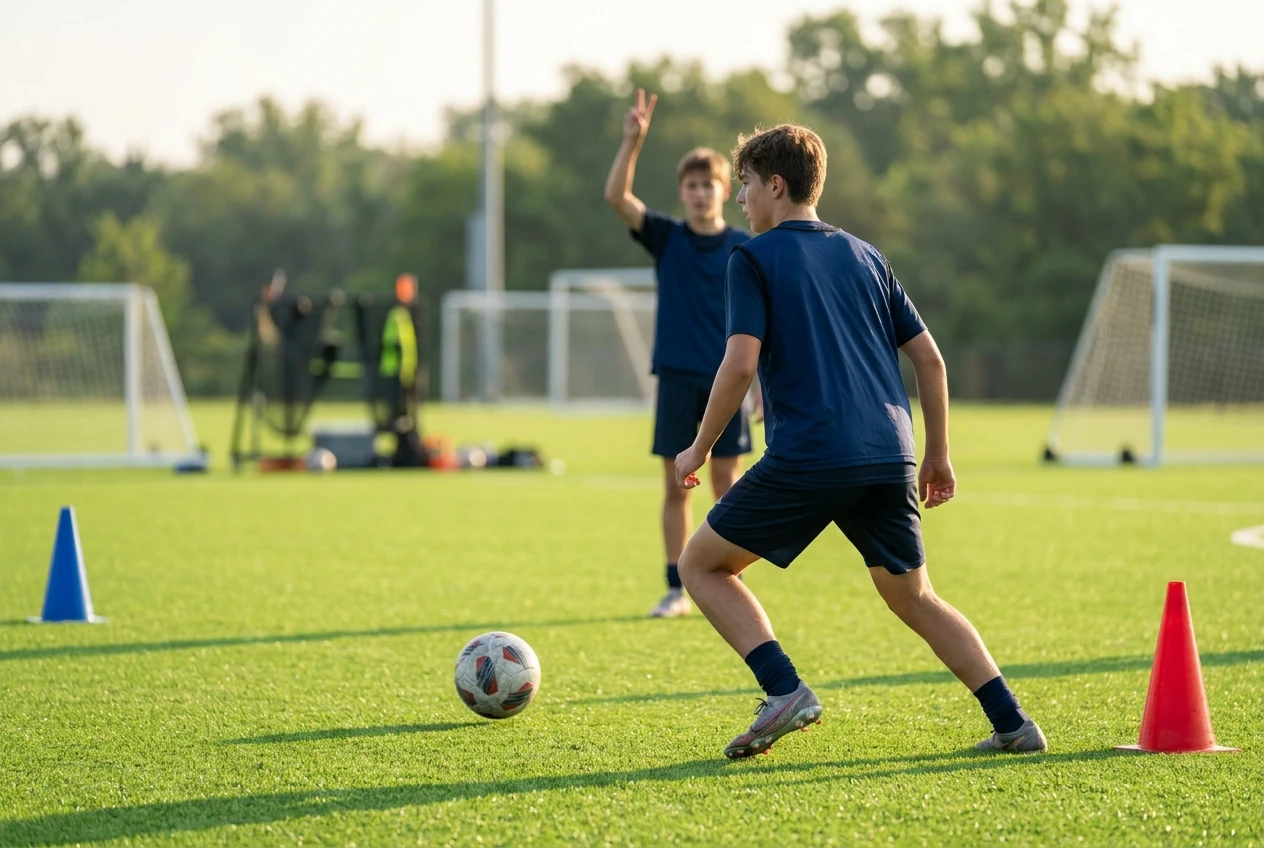
Constraints. Limit what you are allowed to do so the old habit is not available. If your pattern is playing safe backward, play a version where the first pass must go forward or to the far side. If your pattern is too many touches, restrict yourself to two touches. A constraint removes the easy choice and makes the harder one routine.
Quick-choice work. Add a signal that arrives late, so you have to decide fast. A partner can hold up a number of fingers, or point left or right, as the ball arrives. Assign each signal to an option, such as one finger for a pass to the left cone and two for a pass to the right. This trains the decision to happen before the first touch.
Keep sessions short and focused, around 10 to 15 minutes on your one pattern. Short, repeated sessions with full attention serve you better than a long one where you drift. If you have no partner, a wall or rebounder can return the ball while a stationary signal behind you gives you something to scan for. Our comparison of soccer rebounders for solo practice covers which ones return the ball reliably enough for this.
Cheap training aids that make the drill harder without a coach
You do not need much equipment. A few simple items add the unpredictability that a coach would normally supply.
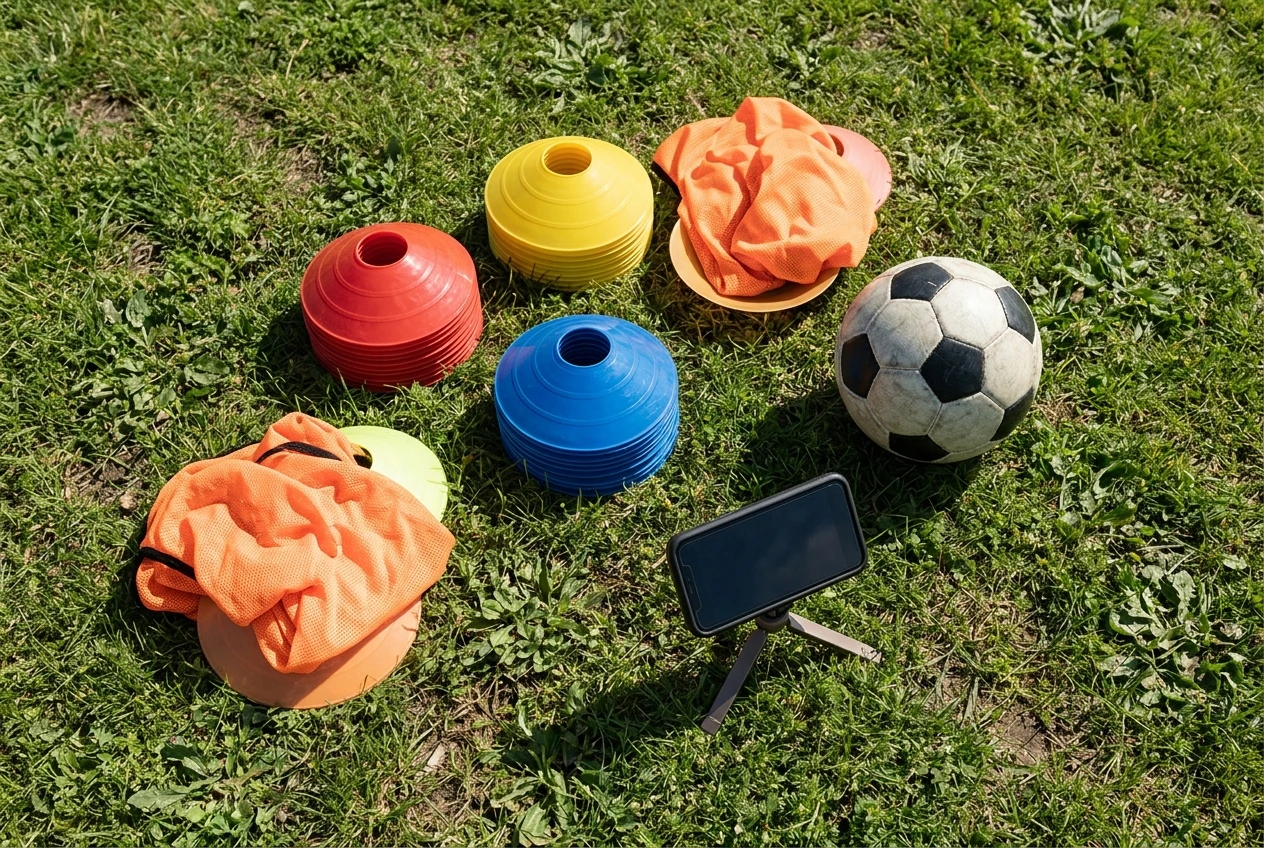
- Colored cones or discs: Different colors give you something to be called toward. See training cones or agility markers for which one suits which drill.
- Pinnies or bibs: Drape them over cones to mark defenders or off-limits zones.
- A wall or rebounder: It returns the ball at different speeds and angles if you vary how hard you strike it.
- A willing friend or sibling: One person calling a color, number or direction at the right moment is enough to make a scanning drill work.
- Your phone: Set a repeating timer or beep to force a decision window, or record the session so you can check that you are actually looking.
If you want a space for this at home, a small corner is enough. The home training setup guide shows how to arrange one on a budget.
How to check next match whether the change actually showed up
Film the next match the same way: same camera position, full duration, same fixed review window. Then run the same 30-minute review with the same tags. Changing the method between matches makes the comparison meaningless.
Compare your target pattern in two ways. First, count how often it appeared. If your pattern was “received without scanning,” count the number of clips tagged that way and compare it with the earlier matches. Second, check the quality of the decision when you did scan. A scan that leads to the same bad choice means the problem is in the option question, not the scan, and your next drill should target that.
Expect uneven results. One match may show a clear change and the next may not, because opponents and game situations differ. Look at the direction across two or three matches before you decide whether the drill is working. If the pattern has dropped, pick a new one from your tags and repeat the cycle. If it has not, change the drill, not the review. Make the constraint stricter or the signal later.
Pick the one decision pattern your footage showed, then choose a training aid built for it in our guide to the best soccer training aids for faster decision making skills.